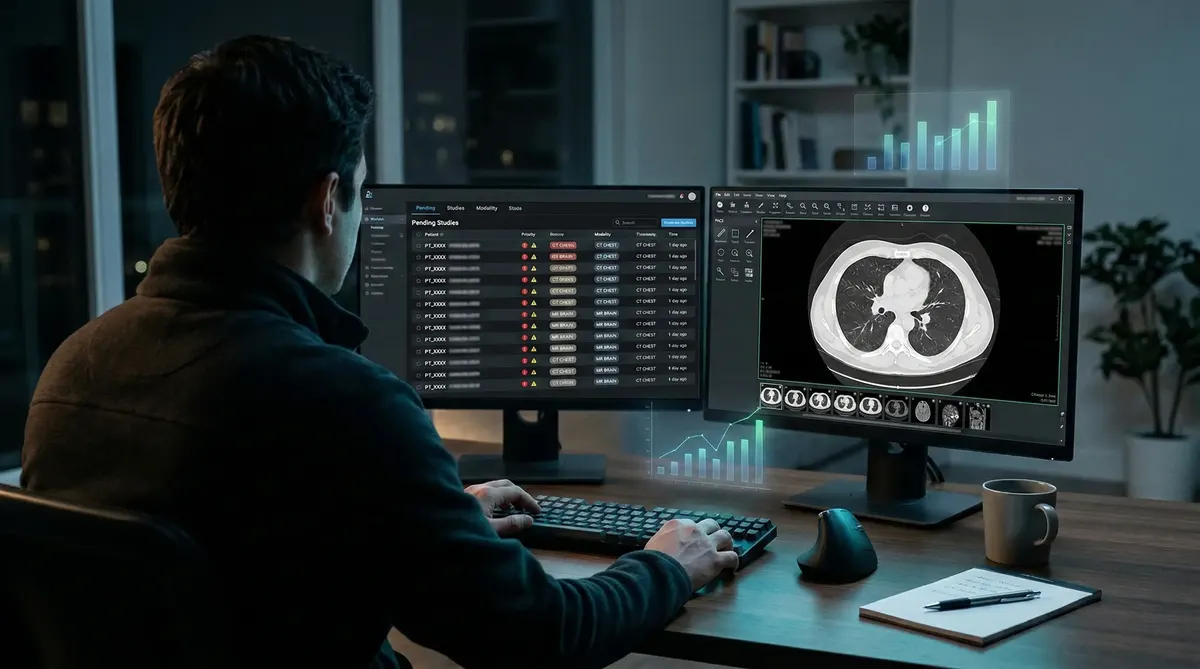
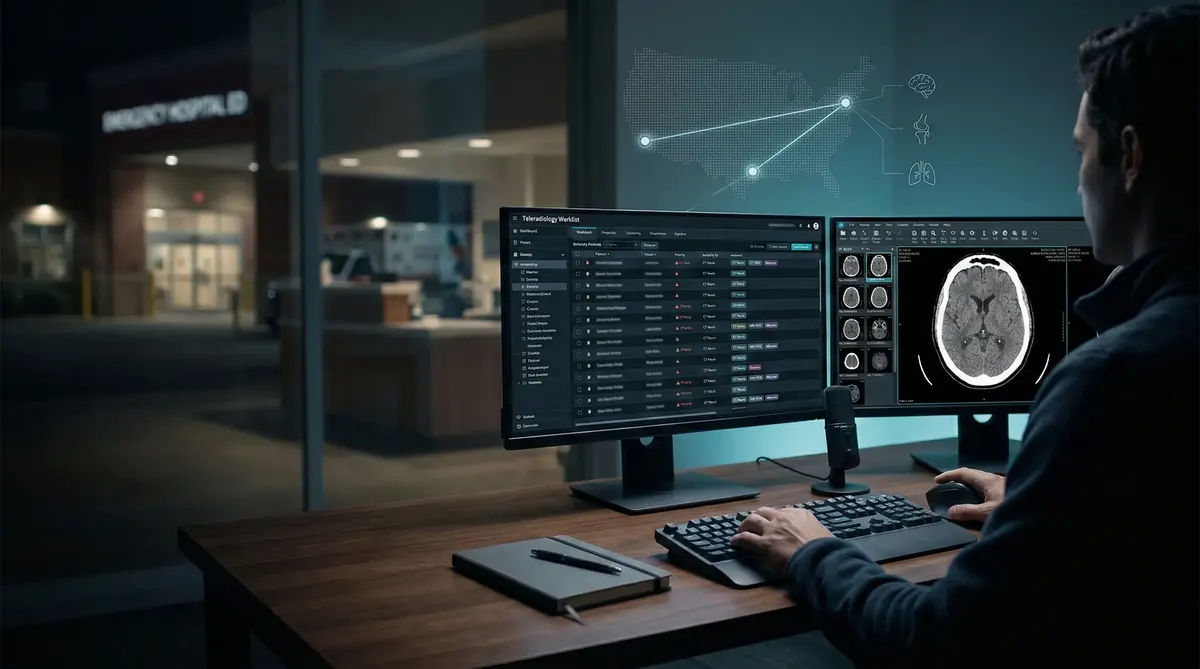
Fellowship-trained neuroradiologists, MSK specialists, body imagers, and pediatric radiologists are overwhelmingly concentrated in urban academic centers. For most hospitals — community, critical-access, regional — hiring even one subspecialist is hard. Staffing enough to cover every modality and shift is effectively impossible.
But the clinical need doesn't care about geography. A complex brain MRI acquired at a community hospital in rural Georgia requires the same expertise as one at a major academic center. The patient deserves the same quality. The referring physician needs the same precision.
The Two-Tier Problem
About 65% of fellowship-trained radiologists practice in metro areas with 500K+ population. For pediatric and breast imaging, the concentration is even more extreme. The result is a two-tier system: academic center patients get subspecialty reads as standard care. Everyone else gets general reads — competent for most cases, but more likely to miss the subtle findings fellowship-trained eyes are specifically trained to catch.
Teleradiology Breaks the Geography Barrier
Through cloud-native PACS and intelligent case routing, a study acquired at any facility gets directed to the right subspecialist in a national network — automatically, in real time, with zero workflow disruption.
This isn't a consult service or a second opinion. It's primary interpretation by fellowship-trained radiologists reading as the attending of record. Same quality as an on-site subspecialist. Same turnaround. Same accountability. Without the recruitment, salary, and retention challenges that make on-site subspecialty staffing impossible for most hospitals.
How the Routing Works
When a study hits the worklist, the system evaluates body region, modality, clinical indication, facility preferences, and available subspecialist capacity to make the optimal assignment. Brain MRI for stroke evaluation goes to neuro. Shoulder MRI with a sports medicine indication goes to MSK. Pediatric chest CT goes to a pediatric radiologist.
- Neuro — brain and spine MRI, CT head/neck, stroke, neurological emergencies
- MSK — joint MRI, sports injuries, bone tumors, spine, orthopedic pre-op planning
- Body — abdominal CT/MRI, oncologic staging, hepatobiliary and pancreatic pathology
- Breast — mammography, breast MRI, tomosynthesis, diagnostic workup coordination
- Pediatric — age-appropriate interpretation, reduced-dose protocols, congenital anomalies
- Cardiothoracic — cardiac CT/MRI, pulmonary imaging, aortic pathology, coronary assessment
The Impact Goes Beyond Accuracy
Subspecialists deliver more specific differentials, more actionable recommendations, and more targeted follow-up guidance. They catch incidental findings within their domain with higher sensitivity. And they communicate with referring physicians using the clinical language that specialists share — making care coordination faster and more efficient.
When a neuroradiologist reads a brain MRI, the referring neurologist doesn't just get a report — they get a clinical conversation partner. That used to require an academic center. Teleradiology makes it available everywhere.
What This Means for Radiologists
For fellowship-trained radiologists, subspecialty teleradiology means your expertise reaches further. You're not limited to the case mix of one institution — you're reading across facilities that genuinely need what you bring. At Rapid Radiology, subspecialists are assigned to specific facilities, learning the case mix, referral patterns, and clinical team preferences over time. The coverage feels local because the relationship is.
For general radiologists, it means working alongside a subspecialty network that handles the complex cases, reduces your cognitive load on edge cases, and makes the practice sustainable. You're not expected to be everything to everyone.
This Gap Won't Close Itself
Training more fellows alone won't solve subspecialty access — the numbers don't support it. What closes the gap is technology that distributes existing expertise more efficiently. Teleradiology is the most proven vehicle for that, and the organizations building robust subspecialty networks today are defining the standard of care for the next decade.