Healthcare is the most targeted industry for cyberattacks, and radiology — with its high-value imaging data, interconnected systems, and increasing reliance on cloud infrastructure — sits squarely in the crosshairs. In 2025 alone, healthcare data breaches affected over 130 million patient records in the United States. For teleradiology organizations that transmit, store, and process imaging data across distributed networks, cybersecurity is not an IT concern — it is a clinical imperative.
The shift to cloud-native teleradiology has introduced both new capabilities and new responsibilities. Cloud platforms offer advantages that on-premises systems cannot match: automatic scaling, geographic redundancy, continuous updates, and centralized security management. But they also require a fundamentally different approach to data protection — one that accounts for the unique risks of distributed imaging workflows.
The Threat Landscape for Teleradiology
The threats facing teleradiology are diverse and evolving. Ransomware remains the most visible risk, with attackers increasingly targeting healthcare organizations because of the urgency of clinical operations and the willingness of health systems to pay to restore access to critical data. But ransomware is only one vector in a complex threat environment.
- Phishing attacks targeting radiologist credentials, which can provide access to PACS and reporting systems containing protected health information
- Man-in-the-middle attacks on imaging data in transit between facilities and cloud infrastructure
- Insider threats from compromised or negligent users with legitimate system access
- Supply chain vulnerabilities in third-party integrations, DICOM viewers, and reporting tools
- Distributed denial-of-service attacks designed to disrupt clinical operations during peak demand
HIPAA Compliance in Cloud-Native Environments
HIPAA compliance is the regulatory baseline for any organization handling protected health information, but compliance alone does not equal security. The HIPAA Security Rule establishes requirements for administrative, physical, and technical safeguards — and cloud-native teleradiology must address each of these in the context of distributed infrastructure.
For teleradiology organizations, this means maintaining rigorous Business Associate Agreements with cloud providers, implementing role-based access controls that limit data exposure to the minimum necessary for each user's function, and maintaining comprehensive audit logs that track every access to patient data. It means regular risk assessments that account for the specific vulnerabilities of cloud-based imaging workflows, and incident response plans that can be activated within minutes of a detected breach.
Defense in Depth: How Modern Teleradiology Protects Data
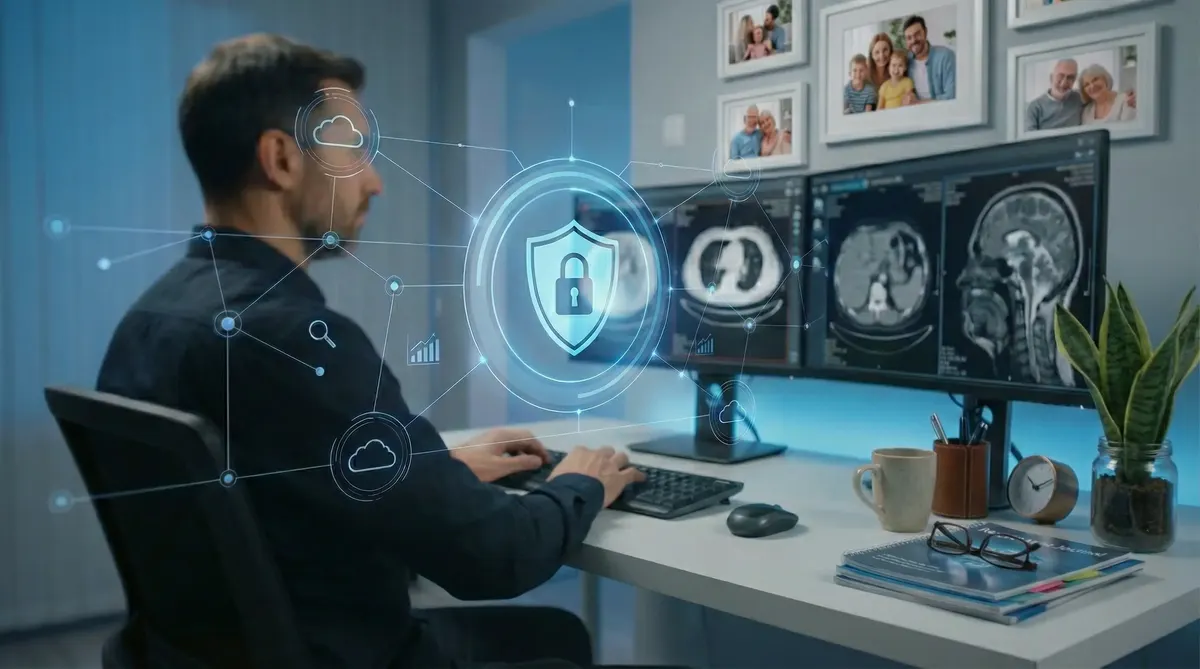
Effective cybersecurity in teleradiology is not about any single technology or control — it is about layered defense that assumes any individual layer can be breached. This defense-in-depth approach creates multiple barriers that an attacker must overcome, dramatically reducing the probability of a successful breach while ensuring rapid detection and containment if one occurs.
Encryption at Every Layer
All imaging data — DICOM files, reports, and patient metadata — must be encrypted both in transit and at rest. In transit, this means TLS 1.3 encryption for all data moving between facilities, cloud infrastructure, and radiologist workstations. At rest, this means AES-256 encryption for all stored data, with encryption keys managed through dedicated key management services that separate key custody from data storage.
Zero-Trust Architecture
The traditional security model of trusting everything inside the network perimeter is incompatible with cloud-native teleradiology, where there is no meaningful perimeter. Zero-trust architecture assumes that no user, device, or connection is inherently trustworthy — every access request is verified, every session is monitored, and every device is validated before being granted access to patient data.
In a zero-trust environment, a compromised credential is an incident, not a catastrophe. The architecture ensures that even authenticated users can only access the specific data and systems required for their current task — nothing more.
Continuous Monitoring and Response
Real-time security monitoring is essential for detecting and responding to threats before they result in data exposure. Modern security operations centers use AI-driven threat detection to identify anomalous access patterns, unusual data transfers, and potential credential compromise — often detecting threats that traditional rule-based systems would miss. When combined with automated incident response playbooks, these systems can contain many threats within seconds of detection.
What Radiologists Can Do
Cybersecurity is not solely the responsibility of IT teams and security architects. Radiologists are both targets and first-line defenders in the security ecosystem. The most sophisticated technical controls can be undermined by a single phishing click or an unsecured home network. Practicing good security hygiene is a professional responsibility that protects patients, colleagues, and the organization.
- Use strong, unique passwords for every clinical system and enable multi-factor authentication wherever available
- Verify the source of unexpected emails, especially those requesting credentials or urgent action
- Ensure your home network is secured with WPA3 encryption and a dedicated VLAN for clinical work
- Keep all devices updated with the latest security patches and operating system updates
- Report any suspicious activity immediately — early detection is the most effective defense
- Complete all required security training and stay current on emerging threat patterns
Security as a Competitive Advantage
For teleradiology organizations, robust cybersecurity is not just a compliance obligation — it is a competitive advantage. Health systems evaluating teleradiology partners increasingly prioritize security posture alongside clinical quality and operational reliability. Organizations that can demonstrate SOC 2 compliance, regular penetration testing, and transparent security practices earn the trust that underpins long-term partnerships.
At Rapid Radiology, security is embedded in every layer of our infrastructure and every aspect of our operations. Our cloud-native platform is built on enterprise-grade security architecture with encryption, zero-trust access controls, continuous monitoring, and rigorous compliance frameworks. Because when patients trust their data to the healthcare system, that trust extends to every organization in the care chain — including us.