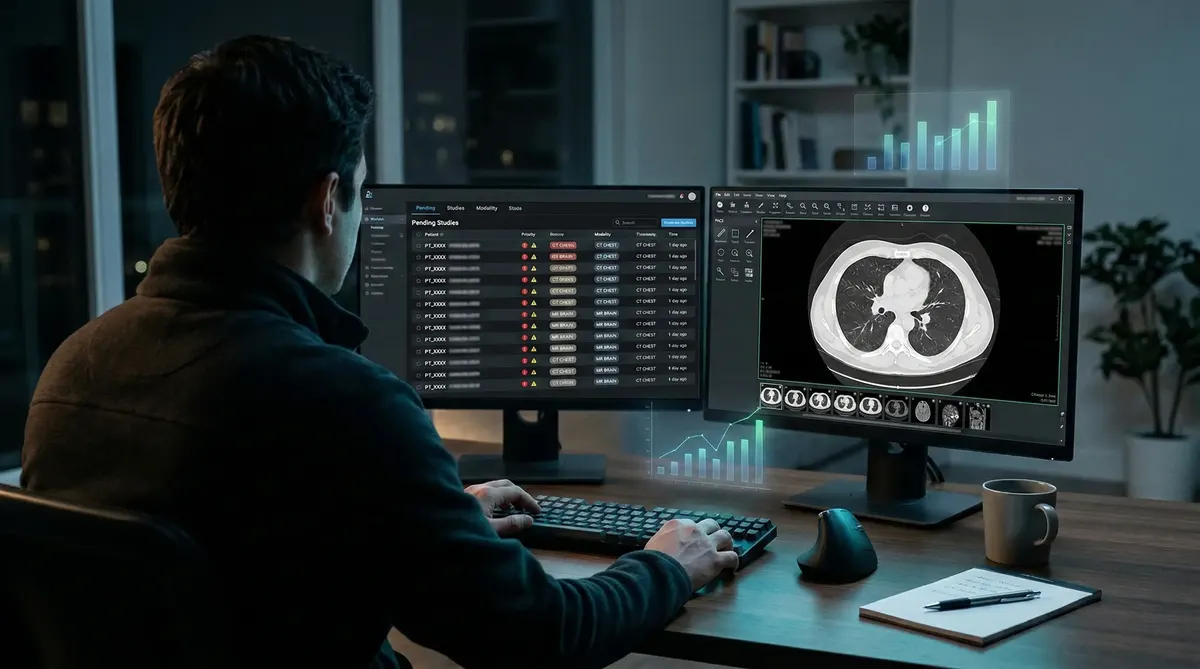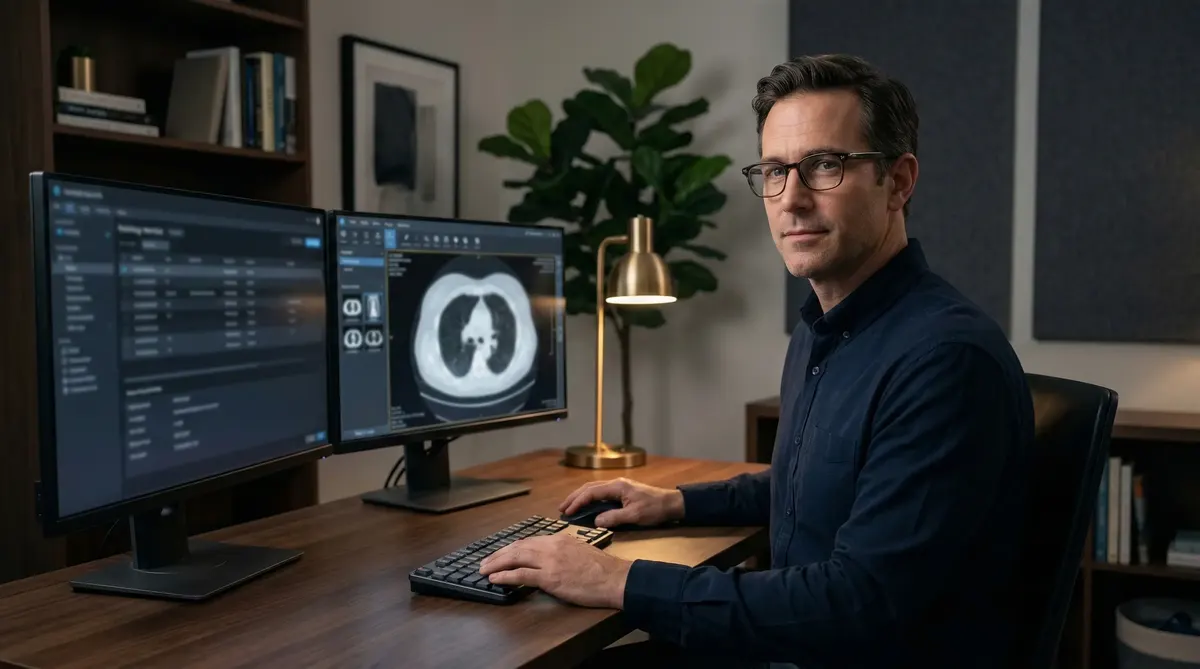

Locum radiologists look like a quick fix on paper. Fill a gap, keep throughput moving, buy time. But for hospital CFOs who've run the numbers, the math doesn't hold up. The true cost of patchwork radiology coverage goes far beyond the daily rate — and it compounds every quarter.
Imaging volumes are climbing. The radiologist shortage is getting worse, not better. And the health systems that are pulling ahead aren't scrambling for the next locum — they're building always-on teleradiology partnerships that deliver consistent quality, predictable costs, and capacity that actually scales.
What Locums Actually Cost You
The daily rate is the beginning, not the bottom line. Add credentialing timelines, travel stipends, housing, agency markups, and the productivity hit while each new locum learns your systems — and the true cost per study runs two to three times higher than a permanent or teleradiology solution.
Then there's the cost you can't invoice for. Rotating locums mean inconsistent reporting. Addendum rates go up. Callbacks increase. Every new locum has to learn your facility's protocols, your referring physicians' preferences, and your PACS workflow — then they leave, and the next one starts from scratch.
The Quality Problem You Can't Afford to Ignore
Quality inconsistency is the real risk. Every time a new locum sits down at your workstation, there's a calibration period. Referring physicians lose confidence when reporting styles change week to week. Subspecialty gaps show up when the locum's expertise doesn't match your case mix. And critical findings communication — the backbone of patient safety — is most vulnerable during these handoffs.
The impact is measurable: more peer review discrepancies, longer turnaround during onboarding, and a higher likelihood of communication breakdowns on critical cases. For any system tied to value-based contracts, that's not just a quality issue — it's a liability.
What Always-On Teleradiology Actually Looks Like
Modern teleradiology isn't the overnight prelim model from fifteen years ago. Today's partnerships deliver full-service coverage across every shift, modality, and subspecialty — from the same team of board-certified radiologists who already know your facility, your protocols, and your referring physicians.
That consistency is the difference. When the same radiologists read for your facility week after week, they build institutional knowledge that locums never develop. They learn your case mix. They build relationships with your clinical teams. They catch patterns a rotating outsider would miss.
- Predictable monthly costs — no agency markups, no travel stipends
- Credentialing handled once and maintained by the teleradiology partner
- Consistent reporting from radiologists who know your facility
- Capacity that scales with volume — no additional recruitment cycles
- 24/7 subspecialty coverage without maintaining a full in-house team
- Closed-loop critical findings communication, built in
The ROI Goes Beyond the Spreadsheet
Most health systems that make the switch report 20–40% reductions in total coverage costs. That alone makes the case. But the ROI extends further: faster turnaround times that accelerate patient throughput, fewer addenda that eliminate downstream rework, and subspecialty access that keeps complex cases in-house instead of referring them out.
For systems on value-based contracts, the quality consistency of a dedicated teleradiology team directly supports the metrics that matter. Faster, more accurate reads translate to shorter lengths of stay, smoother ED throughput, and higher patient satisfaction scores.
Health systems that switch from locum-dependent coverage to dedicated teleradiology partnerships typically see a 20–40% cost reduction, with measurable improvements in turnaround time and reporting consistency within the first 90 days.
How to Evaluate a Teleradiology Partner
Not all teleradiology providers deliver the same value. The best ones operate as an extension of your radiology department — not a separate vendor. They invest in cloud-native PACS that integrates with your infrastructure. They assign dedicated teams to your facility, not whoever happens to be available.
- Board-certified, U.S.-based radiologists with subspecialty depth
- Cloud-native PACS with seamless integration into your existing systems
- Dedicated radiologist teams assigned to your facility
- Transparent quality metrics and regular performance reporting
- 24/7 operational support with real-time case coordination
- Flexible contracts that scale with volume — no long-term lock-in
Making the Switch Without the Disruption
The transition doesn't have to be a lift. Most health systems start with a pilot — nights, weekends, or a single modality — and expand from there as the value becomes obvious.
Credentialing, often cited as a barrier, is actually one of the strongest arguments for teleradiology. An established partner maintains a pre-credentialed roster, cutting the time from contract to first read dramatically. Compare that to the 30–90 day credentialing cycle for each individual locum, and the operational advantage speaks for itself.
The Bottom Line
Locum tenens coverage made sense in a different era. But as the shortage deepens and volumes keep growing, patchwork staffing is too expensive, too inconsistent, and too risky for health systems accountable for both cost and quality.
Always-on teleradiology delivers what locums can't: predictable costs, consistent quality, scalable capacity, and real institutional continuity. For CFOs ready to break the locum cycle, the question isn't whether to make the switch — it's how soon.