The headlines have been predicting the end of radiology for nearly a decade. Geoffrey Hinton said in 2016 that radiologists would be obsolete within five years. It's 2026, and there's a national shortage. The gap between the hype and reality tells you everything you need to know about both the limitations of AI and the irreplaceable value of the radiologist.
AI isn't replacing you. It's handling specific, well-defined tasks — triage, measurement, quality checks — so you can focus on the complex diagnostic reasoning, clinical correlation, and patient communication that no algorithm can touch. That distinction matters, whether you're evaluating your next career move or just trying to cut through the noise.
What AI Is Actually Doing Right Now
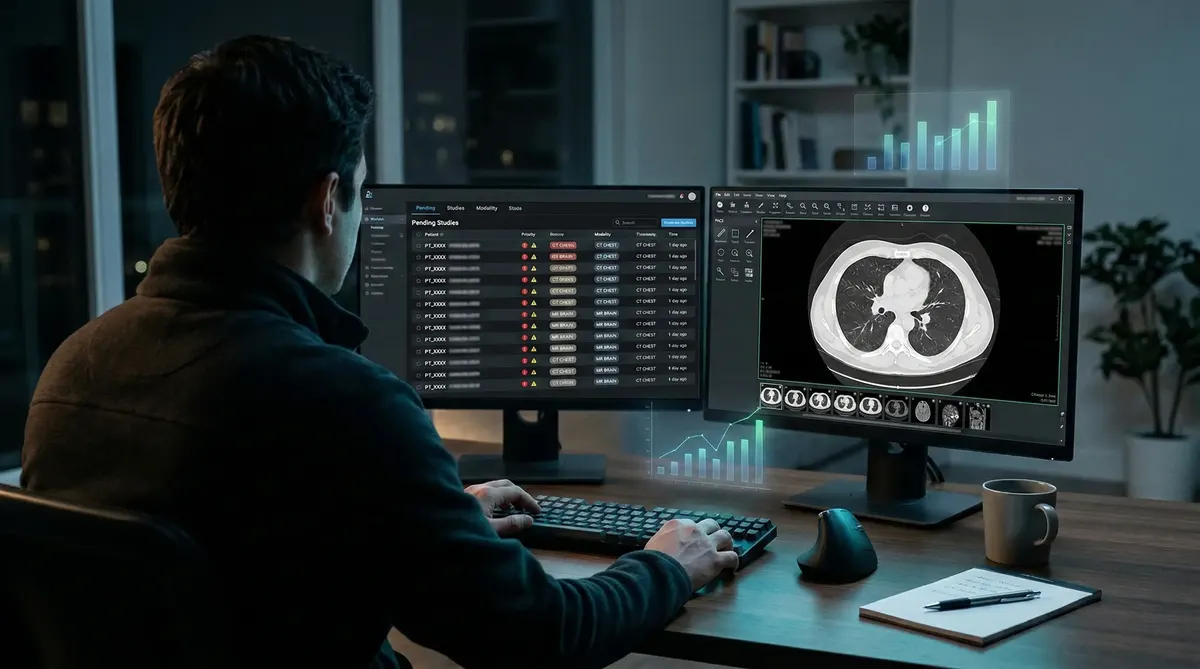
The AI tools making a real difference in radiology aren't the ones writing final reports or replacing clinical judgment. They're workflow tools — systems that operate alongside you to reduce friction, surface urgent findings faster, and eliminate the repetitive tasks that eat time without adding diagnostic value.
- Triage algorithms that flag intracranial hemorrhage, PE, and pneumothorax — bumping critical cases to the top of your worklist within seconds
- Automated measurement tools that track lesion size, calculate organ volumes, and compare serial studies without manual clicks
- Image quality optimization that reduces noise and corrects artifacts in real time — especially useful on suboptimal studies
- Incidental finding detection that flags abnormalities outside the primary clinical question, acting as a safety net
- Structured reporting assistance that pre-populates templates with AI-extracted measurements, cutting dictation time
It Supports Decisions. It Doesn't Make Them.
AI excels at pattern recognition within narrow parameters: detecting a specific finding on a specific study type. What it can't do is integrate that finding with the patient's history, weigh it against competing diagnoses, consider downstream implications, and communicate the result in a way that guides clinical action.
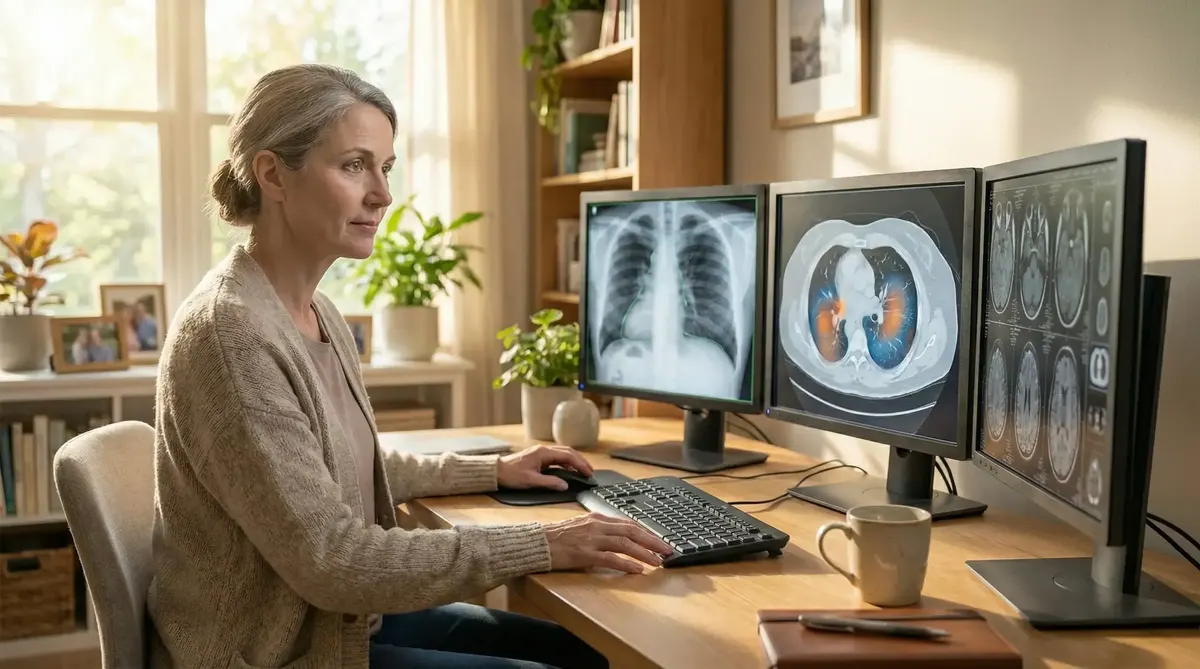
A chest CT gets flagged for a possible pulmonary nodule. The algorithm detects it with high sensitivity. But whether that nodule is clinically significant depends on context that lives outside the image: smoking history, priors, current symptoms, oncologic background, and the clinical question that prompted the study. You synthesize all of that. The AI gives you one data point.
AI never tires, never loses focus, and never skips a measurement. It also never understands why the measurement matters. You provide the why.
AI Doesn't Shrink Your Role — It Elevates It
As algorithms take on more routine detection and measurement, your value concentrates in the areas that require human expertise: complex differentials, multidisciplinary consults, quality oversight of AI outputs, and the clinical judgment that turns imaging findings into actionable decisions.
The radiologists who'll thrive in an AI-augmented environment are the ones leaning into clinical correlation, building deep subspecialty expertise, and treating AI as a tool that amplifies what they do — not a threat to it.
Why Teleradiology and AI Are a Natural Fit
Teleradiology's cloud-native infrastructure — high-throughput PACS, intelligent worklist routing, centralized quality systems — is the ideal foundation for AI at scale. Instead of deploying tools facility by facility, teleradiology organizations roll out algorithms across their entire network with consistent performance and continuous improvement.
At Rapid Radiology, AI is embedded in the workflow, not bolted on. PriorityWorklist uses AI-driven triage to surface critical cases faster. Quality systems use algorithmic analysis to spot patterns and drive improvement. Radiologists get AI-assisted tools that cut manual measurement time and improve reporting consistency — with complete clinical authority over every diagnosis.
What to Look for (and Watch Out For)
As AI tools multiply, approach them with informed skepticism. The questions that matter aren't about accuracy in controlled studies — they're about real-world utility. Does it fit your workflow or add more clicks? Does it reduce cognitive load or pile on alerts? Has it been validated on populations like the ones you read?
- Ask about training data composition and known limitations — not just headline accuracy
- Test workflow integration — tools that create friction won't get used
- Look for real-world performance data, not just retrospective studies
- Confirm the organization maintains radiologist final authority over every read
- Choose practices that deploy AI thoughtfully, not ones that stack every algorithm available
The Future Is Augmented, Not Automated
Radiology in 2030 will look different — but you'll still be at the center of it. AI will handle more routine detection, measurement, and QA. You'll spend more time on what matters most: complex diagnoses, clinical consults, and the integrative thinking that turns images into answers.
If you're thinking about your next move, the question isn't whether AI will affect your practice. It will. The question is whether you'll be in an environment that deploys it thoughtfully, protects your clinical autonomy, and treats technology as something that empowers you — not replaces you.